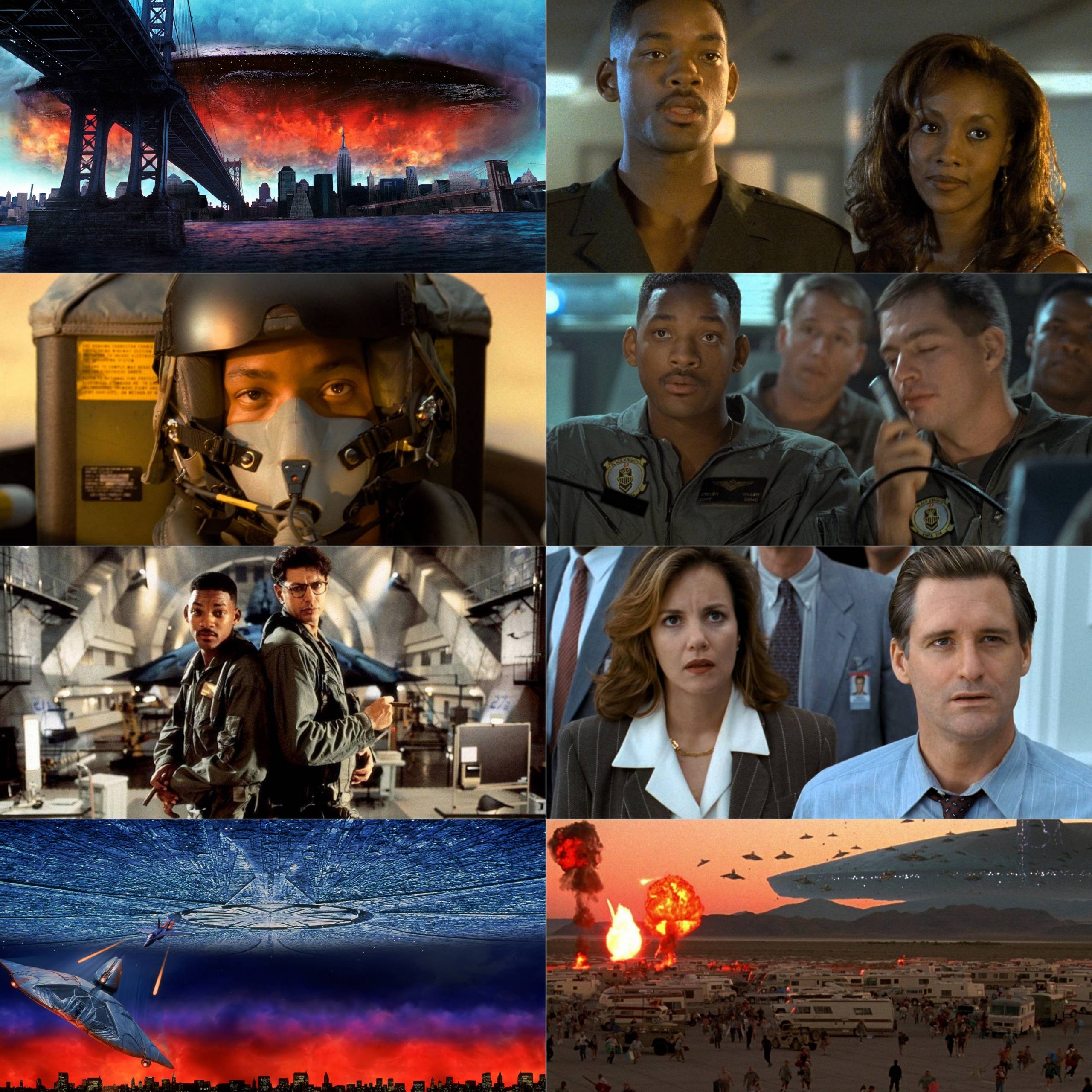












Genre: Action/Sci-fi
Release Date: 1996
Language: Hindi+English
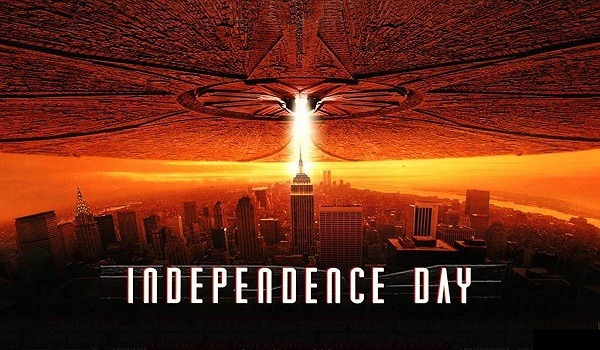
The idea for Independence Day originated in 1994 when director Roland Emmerich and producer Dean Devlin were promoting their previous film Stargate in Europe. During an interview, a reporter asked Emmerich why he created a film like Stargate despite not believing in aliens. Emmerich explained that although he didn’t believe in extraterrestrials, he was still fascinated by the idea of their arrival. He prompted the reporter to imagine waking up one day to find massive 15-mile-wide spaceships hovering over the world’s largest cities. This idea sparked Emmerich’s imagination, and he turned to Devlin, stating, “I think I have an idea for our next film.”
Emmerich and Devlin decided to develop a large-scale alien invasion film, deviating from the typical portrayal of aliens hiding in obscure locations or infecting people secretly. Devlin noted how he disliked that, in most alien invasion films, the aliens are often hidden or arrive in small numbers, saying, “If you were coming across the galaxy, would you hide on a farm or make a big entrance?” The two wrote the script while on a month-long vacation in Mexico, and 20th Century Fox greenlit the screenplay just one day after receiving it. Pre-production began in February 1995, just three days after approval. Although the U.S. military initially offered to provide resources for the film, they withdrew their support when the filmmakers refused to remove references to Area 51.
The movie’s visual effects required over 3,000 special effects shots, setting a record at the time. Despite the availability of computer-generated effects, the filmmakers relied heavily on in-camera special effects to save money and achieve more authentic pyrotechnic visuals. Filming was headquartered at Hughes Aircraft in Culver City, California, where the art department, model-making, and pyrotechnics teams worked. The production involved an unprecedented number of miniatures, including city streets, buildings, and iconic landmarks. For instance, the team built a 30-foot-long model of the alien destroyer and a 12-foot-wide model of the mothership. To create the movie’s signature “wall of destruction,” city streets were recreated and tilted upright beneath a high-speed camera while explosions were ignited below the model, resulting in a dramatic visual effect. The White House was also meticulously recreated with a 10-by-5-foot model, which was destroyed using 40 explosive charges in a scene that took a week to plan.
Production designer Patrick Tatopoulos was tasked with creating the aliens. The actual extraterrestrials in the film are small in stature and wear bio-mechanical suits, which are about 8 feet tall and equipped with 25 tentacles. These suits were intentionally designed to avoid looking like “a man in a suit,” maintaining the illusion of an otherworldly presence.
The filmmakers consulted with Christopher Weaver, the founder of Bethesda Softworks, for scientific collaboration. Weaver’s character traits were used as the basis for David Levinson, Jeff Goldblum’s character in the film.
Principal photography began on July 28, 1995, in New York City, and a second unit gathered establishing shots of Washington, D.C., Flagstaff, Arizona, and the Very Large Array in New Mexico. Filming moved across several locations, including Cliffside Park, New Jersey, and the former Kaiser Steel mill in Fontana, California, where post-attack Los Angeles scenes were shot. Some of the desert sequences were filmed in Wendover, Utah, which doubled as the Imperial Valley, while Wendover Airport was used as the exterior of Area 51. It was at this location that Bill Pullman filmed his famous pre-battle speech. Initially, the movie was going to be called Doomsday, but when Devlin and Pullman decided to add the line “Today, we celebrate our Independence Day!” to the speech, it helped convince Fox executives to secure the title Independence Day, winning the rights from Warner Bros. two weeks later.
The production also used the Bonneville Salt Flats for a few scenes and returned to Los Angeles for additional shooting. Some sets, like the Area 51 interiors, were constructed at a former Hughes Aircraft plant, and corridors featuring windows were initially covered with blue material for chroma key effects. However, these visual effects were never added, as the filmmakers decided that the blue panels gave the set a more “clinical” look. The Area 51 attacker hangar set contained a massive 65-foot-wide alien ship mockup, which took four months to build. Filming wrapped on October 8, 1995, after 72 days of production.
One of the film’s key scenes, originally showing Russell Casse (Randy Quaid) being rejected as a pilot volunteer because of his alcoholism, was re-shot after test audiences responded positively to the irony of the scene. In the final version, Russell becomes a volunteer and flies an F/A-18 fighter jet, sacrificing himself to save humanity.
Music
The Grammy Award-winning score for Independence Day was composed by David Arnold and featured a 90-piece orchestra and a 46-member choir. The film’s producer, Dean Devlin, humorously remarked that “you can leave it up to a Brit to write some of the most rousing and patriotic music in the history of American cinema.” The soundtrack was released twice: first by RCA with a 50-minute album at the time of the film’s release, and later in 2010 by La-La Land Records, which produced a limited-edition two-disc set containing the full score and alternate cues. To celebrate the film’s 20th anniversary, the Independence Day score was performed live at a special screening of the film at the Royal Albert Hall in September 2016. The event featured a pre-film talk by composer David Arnold.